
BenchmarksClosed 13 Nov
  • TA-354,053.83↓ -0.49%
  • TA-1253,935.81↓ -0.60%
  • USD/ILS3.20↑ +0.16%
Israel Today
WorldIsrael

Israel's President Tasks Eisenkot With Forming Government, Ex-General Open to Netanyahu Joining

President Isaac Herzog has officially tasked opposition leader Gadi Eisenkot with forming Israel's next government, setting up a six-week window in which the former military chief must overcome deep political divisions.

By PaulPublished 3 min read
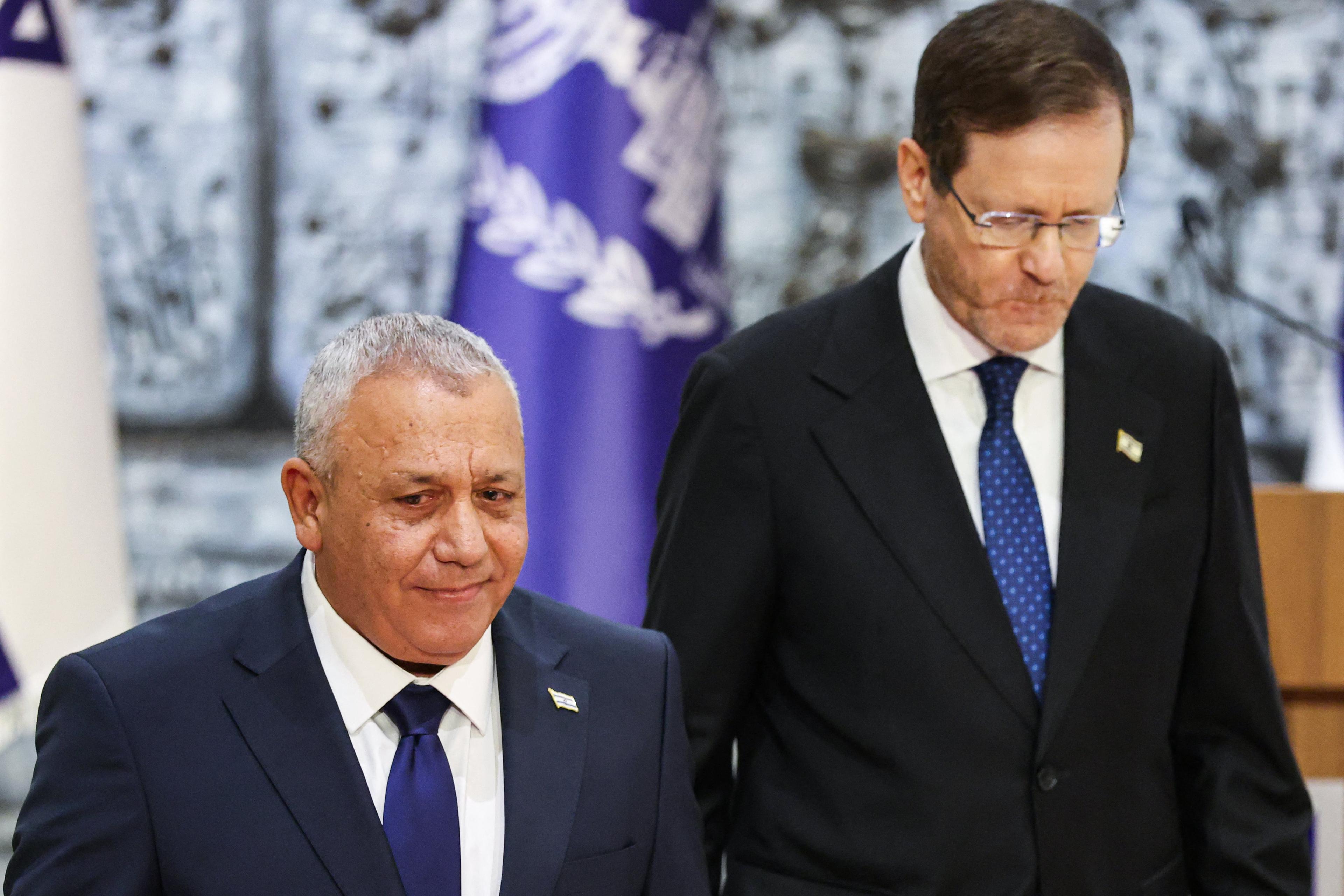
Israel's President Isaac Herzog and opposition leader Gadi Eisenkot attend a press conference in Jerusalem on November 8, 2026.
Israel's President Isaac Herzog and opposition leader Gadi Eisenkot attend a press conference in Jerusalem on November 8, 2026. · Photo: Ilia Yefimovich/AFP

Israeli President Isaac Herzog has given opposition leader Gadi Eisenkot the formal mandate to form the country's next government, handing the former Israeli military chief a chance to end Prime Minister Benjamin Netanyahu's long tenure in office.

The ceremony took place on Sunday at Herzog's office in Jerusalem. Eisenkot, who led Israel's military from 2015 to 2019 and later served as an observer in Netanyahu's war cabinet, now has six weeks to assemble a coalition capable of winning a parliamentary confidence vote.

Eisenkot reaches across the aisle

In a notable gesture, Eisenkot said he was open to including Netanyahu and members of his Likud party in the next government. He also suggested that Finance Minister Bezalel Smotrich, one of the most far-right figures in Israeli politics, would be welcome to join if he accepted the principles Eisenkot laid out.

"If members of Likud and the Religious Zionist Party truly believe this is a time for unity, as they told the president, I cannot conceive of any reason why they would not support a government under my leadership and the principles I have presented," Eisenkot said during the ceremony.

The remarks were striking because Eisenkot ran as Netanyahu's main rival in the October 27 elections and has been embraced by much of the anti-Netanyahu camp. His willingness to bring Netanyahu into a coalition reflects both the fragmented election result and the difficulty of building a stable majority without crossing ideological lines.

A closely divided parliament

The election produced no clear winner. Eisenkot's four-party alliance won 48 seats, while Netanyahu's right-wing and religious bloc took 53. Both fell short of the 61 seats needed for a majority in the 120-seat Knesset. Arab-led parties, representing Palestinian citizens of Israel, won a record 19 seats.

Eisenkot has ruled out forming a government with the Arab-led parties, even though their support would give him a 67-seat bloc. Instead, he is aiming to win over the two ultra-Orthodox parties, United Torah Judaism and Shas, which together would give him exactly 61 seats. Alternatively, he could try to form a minority government and survive a confidence vote with fewer than 61 seats.

Herzog warns of regional uncertainty

Herzog said Israel urgently needs a stable government, pointing to what he called a "new political reality" in the United States after the November 3 midterm elections. Those elections brought victories for several political figures critical of Israel and of continued US military support for the country.

"The State of Israel needs a stable government," Herzog said, emphasizing that external pressures and shifting alliances make internal unity especially important.

Arab parties backed Eisenkot despite Gaza role

Although Eisenkot sat in Netanyahu's war cabinet during the first eight months of Israel's war on Gaza, Arab-led parties still endorsed him for the mandate to replace Netanyahu. Their support for the mandate did not translate into a coalition partnership, but it underscored the depth of opposition to Netanyahu remaining in power.

Netanyahu remains a blocking force

Netanyahu, who remains caretaker prime minister, still has options to derail Eisenkot's effort. If Eisenkot fails to form a government within the six-week deadline, Netanyahu would likely be the next person tasked with trying. If he also fails, Israel would head to new elections, which could keep Netanyahu in office as a caretaker for months longer.

That possibility has led some of Netanyahu's critics to argue that his best strategy is to stall and force another vote, hoping the political map shifts in his favor. The coming weeks will test whether Israel's divided opposition can convert its numerical advantage into an actual governing coalition, or whether the country's political deadlock will continue.

Tags

  • Israel
  • Gadi Eisenkot
  • Benjamin Netanyahu
  • Isaac Herzog
  • Israeli politics
  • Coalition
Keep scrolling for more stories