
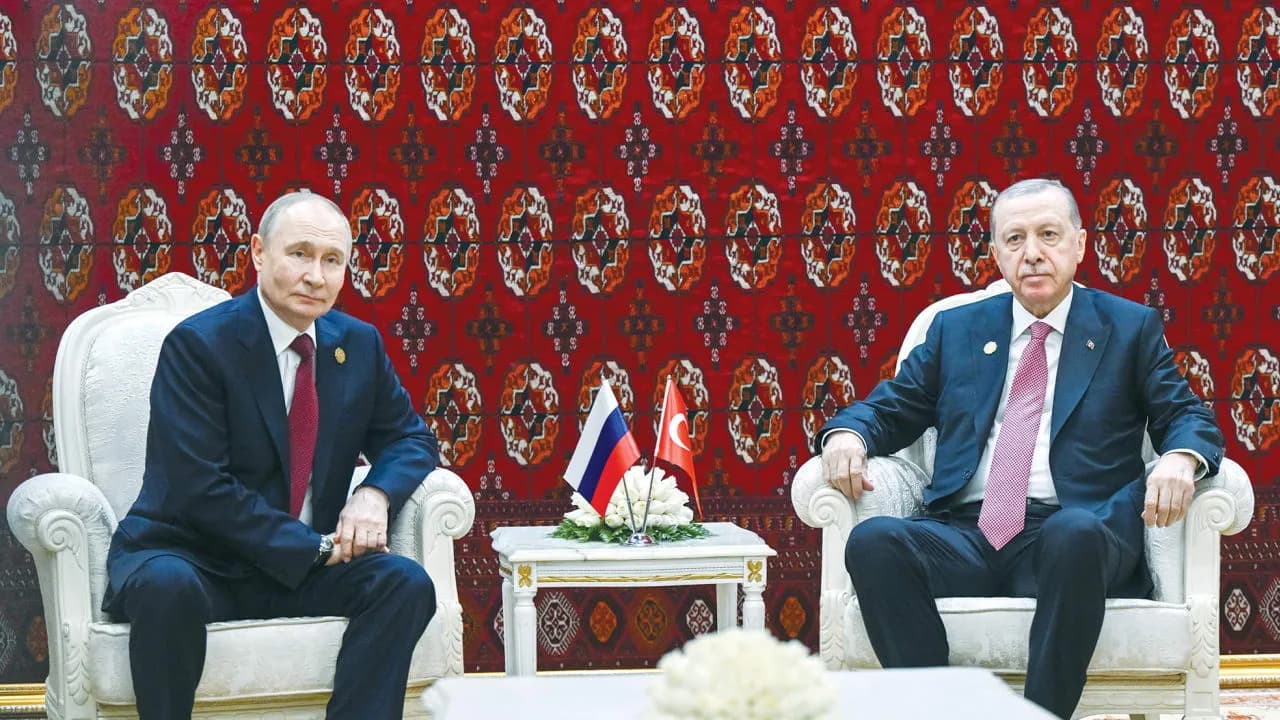
Israeli defense planners are grappling with a new strategic puzzle in Syria, as the deconfliction model Prime Minister Benjamin Netanyahu once built with Moscow faces its most serious test yet with Ankara, according to the Jerusalem Post.
For much of the past decade, Israel's freedom of action over Syrian skies rested on a carefully managed understanding with Russia. That arrangement, forged directly between Netanyahu and Russian President Vladimir Putin, allowed the Israeli Air Force to strike Iranian-linked targets, weapons convoys and Hezbollah supply routes without triggering a confrontation with Russian forces stationed in the country. It was an uneasy but functional coexistence, built on direct communication channels, mutual restraint and a shared understanding of red lines.
That equation has been upended by the collapse of the Assad regime and Russia's diminished footprint in Syria following its prolonged war in Ukraine. Into the vacuum has stepped Turkey, which under President Recep Tayyip Erdogan has moved aggressively to expand its military and political influence over the new Syrian government. Turkish forces now maintain a growing presence across northern and central Syria, positioning Ankara as the dominant outside power shaping Damascus's future.
For Israel, this shift raises an urgent question examined by the Jerusalem Post: can the same style of quiet, pragmatic deconfliction that worked with Russia be replicated with Turkey, a NATO member with a far more complicated and often adversarial relationship with Jerusalem. Unlike Putin, who largely treated Syria as a chessboard for great-power interests while showing limited concern over Israeli strikes against Iranian assets, Erdogan has positioned himself as an outspoken critic of Israeli policy, particularly regarding Gaza, and has cultivated closer ties with Hamas figures over the years.
The stakes are considerable. Israel has continued to carry out strikes inside Syria since Assad's fall, aiming to prevent advanced weaponry, including air defense systems and precision-guided munitions, from falling into the hands of hostile actors or being absorbed by forces aligned with Ankara. Turkish military advisers and equipment, meanwhile, have reportedly been moving into Syrian bases previously used by Russian or Iranian-backed forces, raising concerns within Israel's defense establishment about the kind of long-term strategic foothold Turkey may be establishing along Israel's northern approaches.
Netanyahu's government has signaled it wants to avoid a direct clash with Turkish forces, mindful of the risks of escalation with a NATO military that dwarfs Syria's own defunct armed forces. At the same time, Israeli officials are wary of ceding operational latitude in Syrian airspace, which has become central to efforts at preventing Iran from rebuilding smuggling routes to Hezbollah in Lebanon.
Analysts cited by the Jerusalem Post note that any deconfliction arrangement with Turkey would likely need to look different from the Russian model. Where Moscow's calculus in Syria was driven largely by great-power positioning and had little ideological stake in the Israeli-Iranian rivalry, Erdogan's government blends its regional ambitions with an Islamist-inflected foreign policy that frequently invokes solidarity with Palestinians and criticism of Israeli military actions. That makes backchannel coordination politically more fraught for Ankara, even if its military planners share a practical interest in avoiding unplanned encounters with Israeli jets.
There is also the question of trust and precedent. The Russia channel took years to mature and was tested repeatedly, including after the 2018 downing of a Russian reconnaissance plane by Syrian air defenses during an Israeli operation, an incident that strained but ultimately did not break the arrangement. Whether a similarly resilient understanding can be built with Turkey, given the far more volatile rhetoric between Jerusalem and Ankara in recent years, remains an open question for Israeli strategists.
Complicating matters further is the uncertain trajectory of Syria's post-Assad government itself. Damascus's new leadership, still consolidating control and dependent in part on Turkish backing, has limited ability to act as an independent mediator between Israeli and Turkish interests. That leaves Jerusalem and Ankara needing to manage friction points, whether through direct diplomatic channels, third-party intermediaries, or informal military-to-military contacts, without a stable central Syrian authority to help absorb the tension.
Israeli officials have not disclosed the specifics of any current or planned contacts with Turkish counterparts regarding Syria, and the Jerusalem Post report suggests the situation remains fluid. What is clear, according to the report, is that Israel's defense establishment views the coming months as a critical window in which the rules of engagement over Syrian territory, and by extension the boundaries of Turkish and Israeli influence there, will be tested and potentially redefined.
The outcome will carry implications well beyond Syria's borders. A stable deconfliction understanding with Turkey could help Israel preserve its operational freedom against Iranian-linked threats while avoiding a costly rupture with a major regional and NATO power. A breakdown, by contrast, could open a new front of strategic friction at a moment when Israel is already managing multiple regional challenges, from Gaza to Lebanon to the broader Iranian axis.