
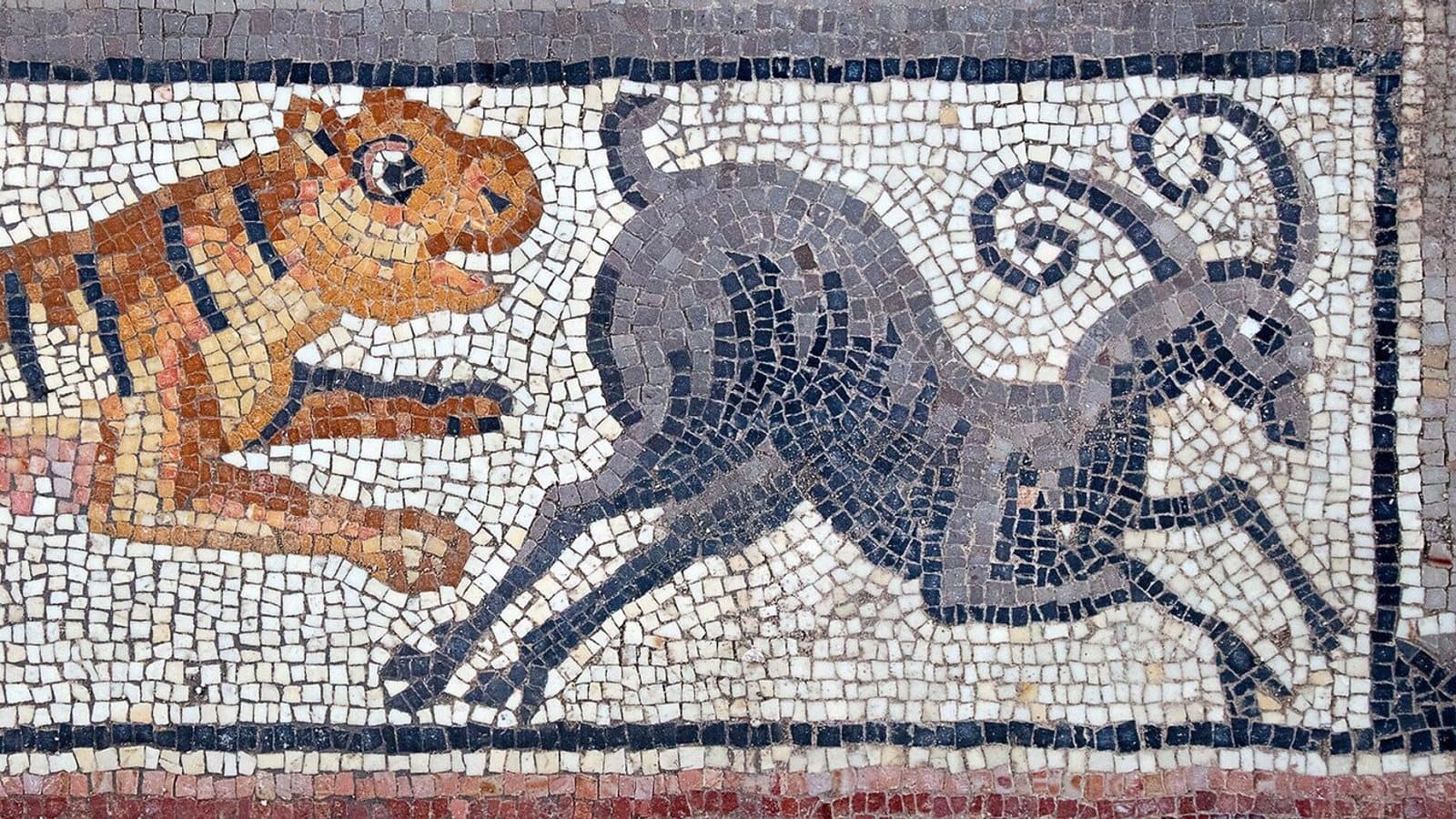
Secrets of Huqoq, an exhibition at the Yigal Allon Center Museum at Kibbutz Ginosar, presents finds from the Huqoq excavation in the Amiad Forest near the Sea of Galilee. The village dates to the Roman and Byzantine period, roughly 1,600 years ago. Excavations have been led by Prof. Jodi Magness of the University of North Carolina at Chapel Hill with the Israel Antiquities Authority.
The synagogue floors are the reason the site is known. Their mosaics run through Samson, Deborah and Yael, the oasis at Elim, Noah's Ark, Jonah, and the parting of the Red Sea. That is a wide biblical programme for a rural synagogue, and it is the range as much as the craftsmanship that has made Huqoq a reference point for what village communities of the period commissioned.
Not everything on display is decorative. A hoard of bronze coins was recovered from an underground escape network beneath the village, along with a ring and a dagger. Tunnels of that kind are evidence of a community that expected to need them.
The work has been supported by JNF-KKL, the WF Albright Institute of Archaeological Research, the Israel Antiquities Authority and the United States government. Showing the finds at Ginosar rather than in Jerusalem keeps them within sight of the ground they came out of, which is not always how excavation material ends up being displayed.